
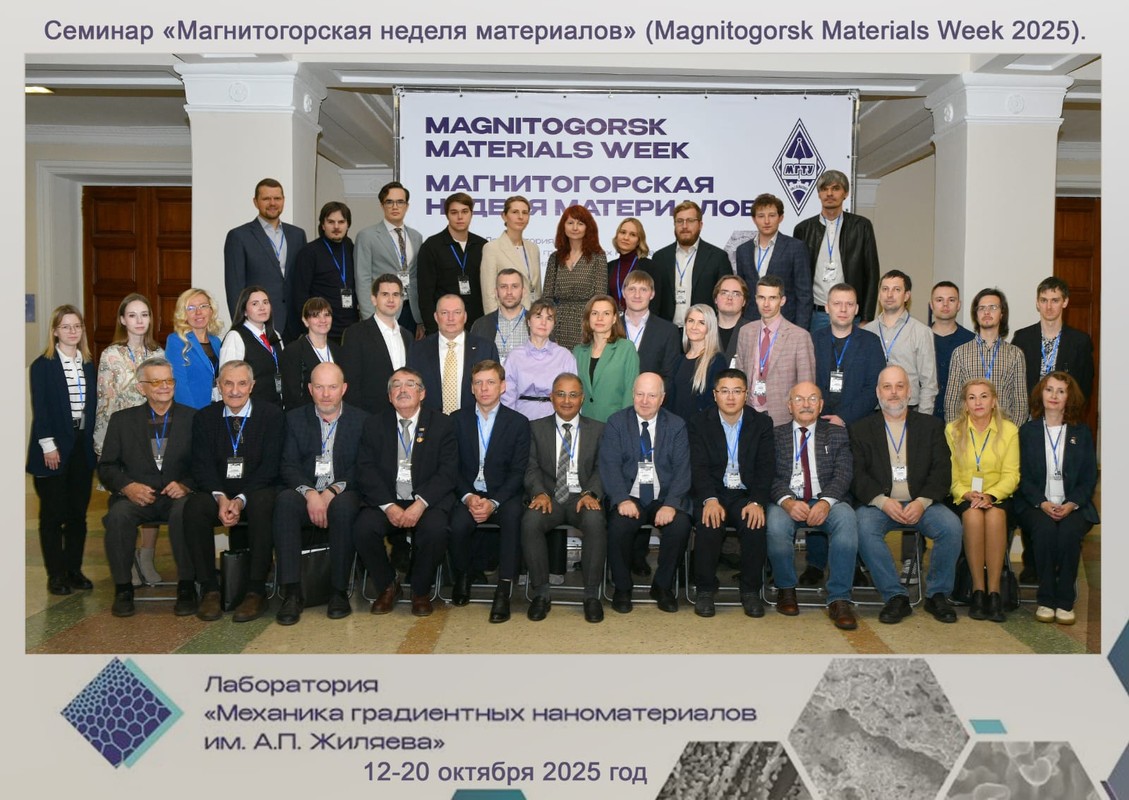
 The Magnitogorsk Materials Week is taking place in the city of metallurgists. Scientists from Russia, China, and India have come together at MSTU. The university is hosting an International Youth Conference, which includes a scientific school that has attracted more than 100 participants from all over the country and abroad. I will tell you about what impressed the foreigners in Russia.
Russia, India, and China are three countries with different cultures and mindsets. However, within the walls of MSTU, everyone speaks the same language. And that language is science.
Liu Jianyu, participant of the Magnitogorsk Materials Week (China):
"This is my first time in Russia. I came from Beijing to Moscow, and from Moscow I came here. And, by the way, I met a lot of Russian people. They are very nice, very friendly. And, of course, the technology of Russian steel and aluminum is very good. I think this is a good trip."
These are the impressions that Liu Jianyu, the CEO of a company that produces metallurgical equipment, will take with him to China. His developments are also used at MMK. This meeting is a dialogue between industries.
Liu Jianyu, participant of the Magnitogorsk Materials Week (China):
"The presentations by professors and factory managers on how to increase the strength and ductility of metals are of particular interest. As a professional, I am interested in knowing what the maximum parameters of our machines should be in order to be of interest to your company, and what we should pay attention to."
Communication is the main goal of such events, says Alexander Pesin, professor at Nosov Magnitogorsk State Technical University and Doctor of Technical Sciences. This is especially important for young people.
Alexander Pesin, Deputy Head of the Zhilyaev Laboratory of Mechanics of Gradient Nanomaterials, Professor, Doctor of Technical Sciences:
"Connections, this is the most important thing. When the conference is held online, there is no communication. And communication at the conference is more important than everything else. This is an opportunity to get connections, get an idea of what is being done by others and show yourself."
To get connections came about a hundred participants - from students to representatives of the largest global enterprises. For Professor Tandon Punith, Magnitogorsk University has become as familiar as the Institute of Information Technology, Design and Production in his homeland, sunny India, where snow is a rare occurrence.
Tandon Punith, Professor at the Indian Institute of Information Technology, Design and Production:
"The weather is nice, and this is the first time I've seen snow. In India, yes, there's no snow in India, so this is a very interesting experience, and I really like the city. The university is very good. I have a lot of friends at the university, but what I like most is the border between Asia and Europe. It's something unique in the world."
It is also unique that Tandon Punit has become an Emeritus professor at Nosov Magnitogorsk State Technical University. He is the first foreign scientist to receive such a title at Magnitogorsk University. For joint work on two projects on the layout of materials and on cold asymmetric rolling. This is one of the three events that led to the Materials Week. The second was the winning of the megagrant, the most prestigious grant from the Russian Science Foundation. And the third is the preparation for the Magnetic Valley project, which will turn MSTU into one of the scientific centers of Russia.