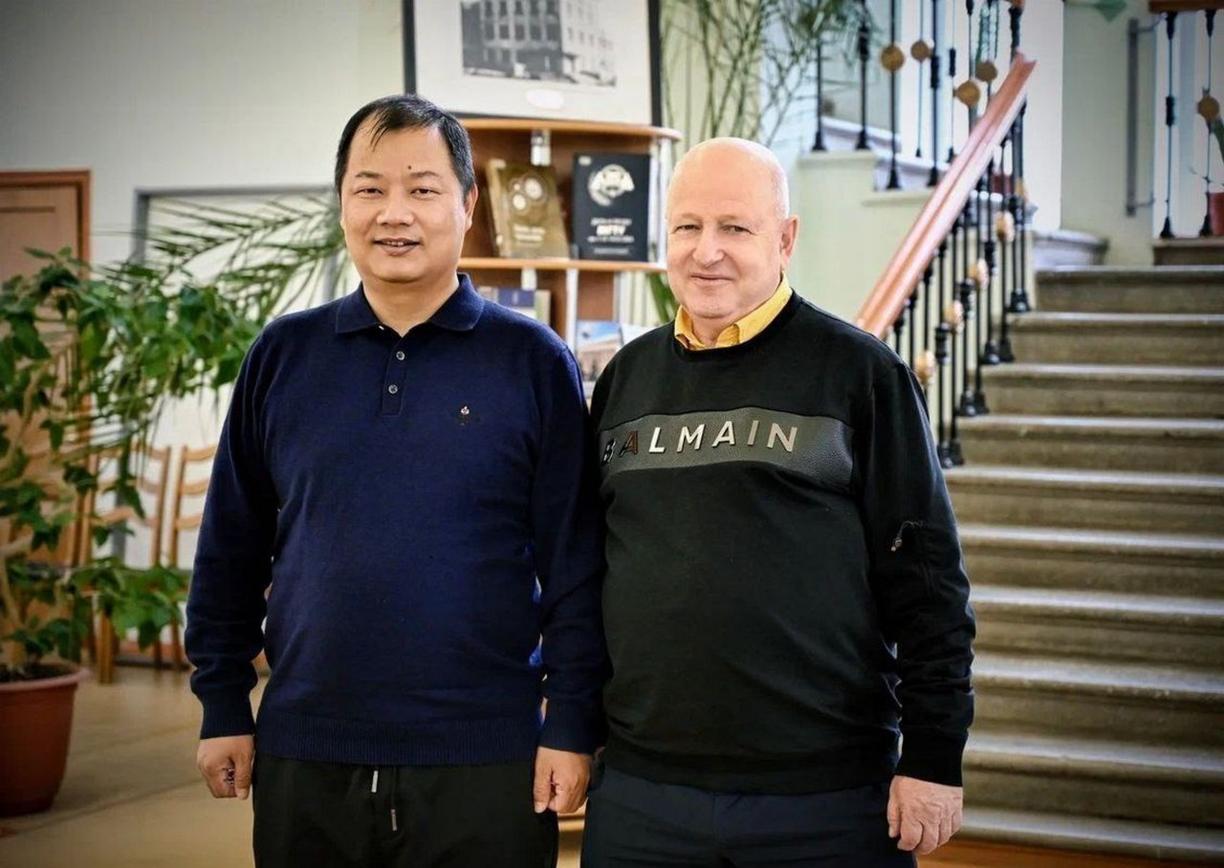
 An outstanding Chinese scientist, Hailiang Yu, has become the head of the Zhilyaev Laboratory of Mechanics of Gradient Nanomaterials at Nosov Magnitogorsk State Technical University. The university has won a mega-grant from the Russian Science Foundation for conducting fundamental research under the supervision of a foreign scientist. This was announced by the university's press service.
"We have been collaborating with Professor Hailiang Yu's laboratory for about 15 years. During this time, we have obtained eight joint Russian patents and 12 scientific articles. In the Russian Science Foundation competition, we took 13th place in the country among all fields, from engineering and natural sciences to medicine and the humanities. The topic of our research is "The phenomenon of dynamic structural and phase transformation during asymmetric rolling of polymorphic alloys and the development of methods for producing new high-tech materials based on it," according to Alexander Pesin, a professor at the Nosov Magnitogorsk State Technical University.
As explained by the university, Professor Yu started working at the university and gave his first lecture, "Russia-China: Advanced Materials and Metallurgical Technologies within the Mega-Grant". The scientist spoke about his achievements, the scientific team, equipment, and prospects for applying his developments in industry, including metallurgy, transport, and mechanical engineering.
"Central South University of China is one of the leading universities in the country and is a global leader in research on aluminum and light alloys. Therefore, I am confident that our collaboration will lead to significant scientific results. Rolling is a key area of metal processing, and we have been working on asymmetric rolling in Russia and China for many years. We have a strong scientific foundation and extensive experience in this field. With the support of this grant, we aim to gain new knowledge and technologies that will be of interest to the global scientific and industrial community," said Professor Hailiang Yu.
Professor Yu will work in Magnitogorsk for at least five years - both remotely, while at the university in Changsha, and in person, spending three months annually in the city of metallurgists. The collaboration may last longer - up to eight years, if the project develops as successfully.